
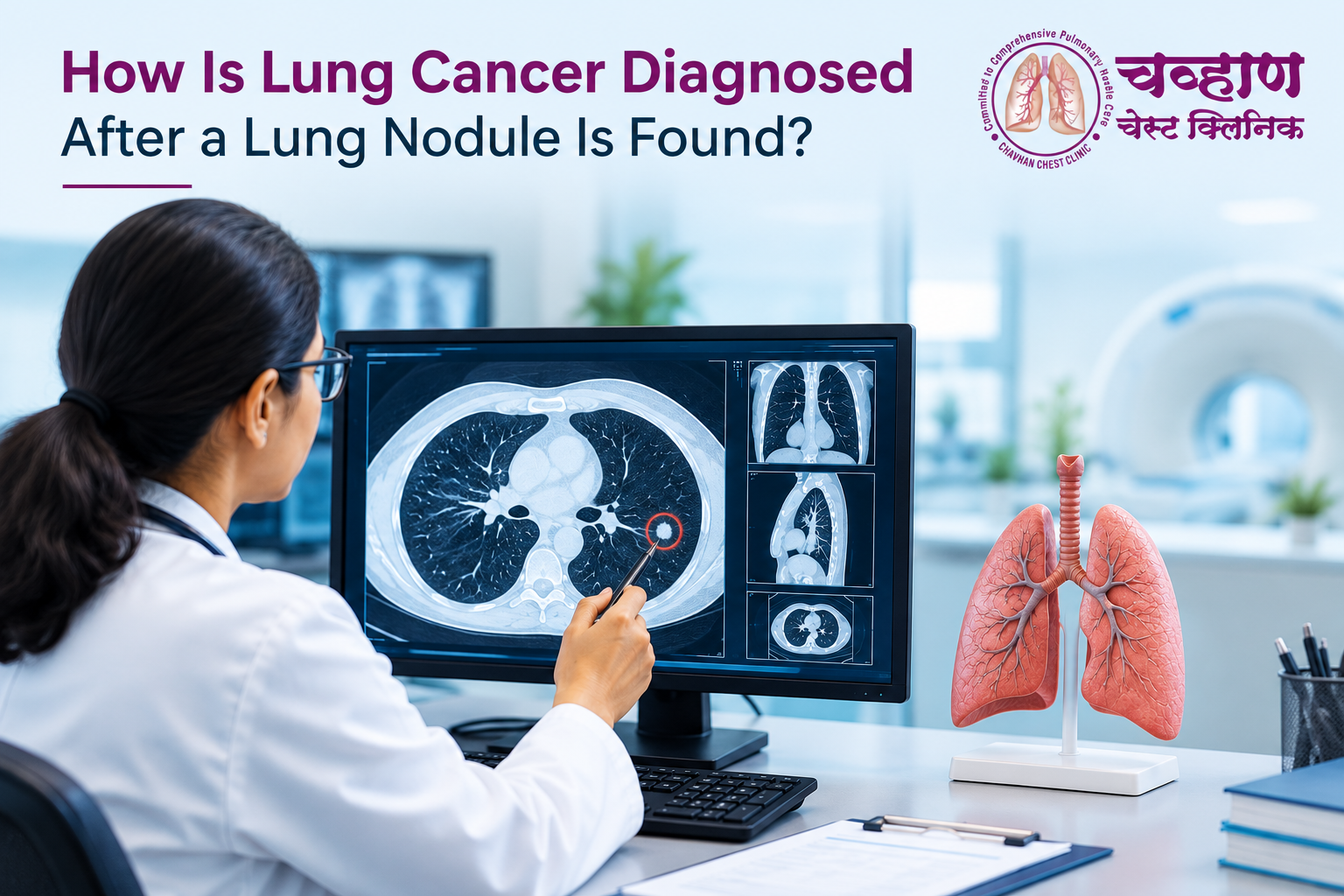
How Is Lung Cancer Diagnosed After a Lung Nodule Is Found?
Hearing that a scan has shown a “spot” or a nodule on your lung is unsettling, even if a doctor mentions it in passing. The first question most people ask is simple: does this mean I have cancer? In most cases, the answer is no. A lung nodule is a finding that needs to be looked at carefully, not a diagnosis in itself, and understanding lung nodule and lung cancer together as two separate but connected topics can make the next few weeks feel a lot less overwhelming.
This article walks through how doctors think about a newly found nodule, what influences their next steps, and how lung cancer diagnosis is actually confirmed when it is needed.
A Lung Nodule Is a Finding, Not a Diagnosis
A lung nodule is simply a small round or oval spot, usually under 3 centimetres, that shows up on a chest X-ray or CT scan. Most nodules are found by accident, when someone gets imaging for an unrelated reason such as a chest infection, a fall, or a pre-surgery workup.
The vast majority of nodules turn out to have nothing to do with cancer. Old infections, healed inflammation, and scar tissue are far more common explanations than malignancy. That said, some nodules do need closer attention, which is exactly why a proper lung nodule cancer diagnosis process exists rather than a single test that gives an instant answer.
What Causes a Lung Nodule?
Understanding lung nodule causes helps explain why doctors don’t jump straight to worst-case conclusions. Common non-cancerous causes include:
- Past lung infections such as tuberculosis or fungal infections that leave behind a small scar (granuloma)
- Pneumonia that has healed but left a visible mark
- Benign growths such as hamartomas
- Inflammatory conditions affecting lung tissue
- Blood vessel abnormalities
Less commonly, a nodule can represent an early lung cancer or, occasionally, a spread of cancer from elsewhere in the body. Because both benign and concerning causes can look similar on a first scan, doctors rely on a combination of imaging patterns, growth behaviour, and personal risk factors rather than appearance alone.
Lung Nodule Symptoms: Why Most People Feel Nothing
One of the more surprising things patients learn is that lung nodule symptoms are usually absent. Most small nodules produce no physical signs at all, which is why they’re so often discovered incidentally rather than because someone felt unwell.
When symptoms are present, they’re generally related to the underlying condition rather than the nodule itself, and can include:
- A persistent cough that doesn’t clear up
- Shortness of breath
- Chest discomfort or a dull ache
- Coughing up blood
- Unexplained weight loss
It’s worth being clear that these symptoms have many possible causes, from asthma and bronchitis to reflux and anxiety, and having one or more of them does not mean a nodule is cancerous. They do, however, matter to your doctor, because symptoms combined with imaging findings shape how urgently further testing is arranged.
What Makes a Nodule “Suspicious”?
Not every nodule is treated the same way, and this is where lung nodule evaluation really begins. When a pulmonologist or radiologist looks at a suspicious lung nodule, several features are weighed together rather than in isolation:
Size. Larger nodules carry a somewhat higher chance of being significant, though small size alone doesn’t rule anything out.
Shape and edges. Smooth, round edges are more often reassuring, while irregular, spiculated (spiky) borders raise more concern.
Density on CT. Nodules are often described as solid, part-solid, or ground-glass. Ground-glass and part-solid nodules behave differently over time compared with solid ones, and part-solid nodules with a solid component are generally watched more closely.
Location. Where in the lung the nodule sits can influence how easily it can be sampled if testing is needed.
Whether it’s new or has changed. A nodule that has appeared since a previous scan, or one that has grown in size, is generally taken more seriously than one that has looked identical for years.
Growth rate. Doctors often look at how quickly (or slowly) a nodule doubles in volume. Very slow-growing or completely stable nodules are reassuring; rapid change is not.
Beyond the nodule itself, personal factors matter just as much:
- Current or past smoking history
- Age
- Family history of lung cancer
- Occupational exposure to substances like asbestos or radon
- Presence of symptoms
- Existing lung disease such as COPD or pulmonary fibrosis
None of these factors alone determines the outcome. A pulmonologist puts the imaging findings and the person’s individual history together to decide what happens next.
The Role of a Lung Nodule CT Scan
A lung nodule CT scan gives far more detail than a plain chest X-ray. It can show the nodule’s exact size, shape, density, and its relationship to nearby structures like blood vessels and airways.
CT imaging can suggest whether a nodule looks more likely to be inflammatory or more likely to warrant further testing, but it’s important to be realistic here: CT scans can raise or lower suspicion, but they cannot examine cells directly. A scan is a very useful screening step within the broader lung nodule evaluation, not a final verdict.
One of the most valuable things a CT scan can do is get compared against previous imaging. If you’ve had a chest CT or X-ray in the past, your doctor will often ask for those old images specifically to see whether the nodule is genuinely new, or whether it has been sitting there, unchanged, for several years. A nodule that looks identical to a scan from three years ago is reassuring in a way that a brand-new nodule simply isn’t, which is why tracking down old films (even from a different hospital) is often one of the first practical steps.
What Happens After a Lung Nodule Is Found?
There isn’t one single pathway that applies to everyone, because lung nodule testing is tailored to how concerning the nodule looks and how it fits with your individual risk profile. Broadly, the options a pulmonologist considers include:
Watchful follow-up. For small, low-risk nodules, especially in people with no major risk factors, a repeat CT scan after a set interval (often a few months) is a reasonable and common approach. If the nodule hasn’t changed, follow-up intervals are usually spaced out further.
Additional imaging, such as PET-CT. A PET-CT scan looks at how actively cells in a nodule are using energy. Nodules that are metabolically active show up more prominently and this can add useful information when a nodule falls into an uncertain category. PET-CT is not needed for every nodule; it’s generally reserved for cases where the size or imaging pattern makes the added information genuinely useful.
Bronchoscopy. This procedure allows a doctor to look inside the airways and, depending on the nodule’s location, take samples from it or from nearby lymph nodes.
CT-guided biopsy or other tissue sampling. For nodules that are harder to reach through the airways, sampling guided directly by CT imaging may be considered instead.
Your pulmonologist decides which combination, if any, applies to your situation. Many nodules never need anything beyond periodic monitoring.
When Is a Lung Nodule Biopsy Needed?
A lung nodule biopsy isn’t automatic just because a nodule has been found, and it’s one of the most commonly misunderstood parts of this process. A biopsy is generally considered when a nodule’s imaging characteristics, growth pattern, or a person’s individual risk factors together suggest that a tissue diagnosis would meaningfully change the plan of care.
The approach used depends heavily on where the nodule sits and how large it is:
- Nodules closer to the central airways may be reachable through bronchoscopy, sometimes with additional guidance techniques to improve accuracy.
- Nodules further out in the lung tissue may be better suited to a CT-guided needle biopsy performed by a radiologist.
- In some situations, a surgical approach may be recommended, particularly if less invasive sampling hasn’t given a clear answer.
Once a tissue sample is obtained, it goes to a pathologist, who examines the cells under a microscope. This step, pathology, is really the heart of confirming or ruling out cancer, because it’s the only way to see the actual cells rather than just their shadow on a scan. Imaging can point toward concern; pathology is what confirms what’s actually there.
To be clear, a biopsy is a tool used selectively, not a routine step for every nodule. Many small, stable, low-risk nodules are followed with imaging alone and never require tissue sampling at all.
How Is Lung Cancer Diagnosis Actually Confirmed?
This is where the distinction between “finding a nodule” and “diagnosing cancer” becomes important. A CT scan, even a very detailed one, can flag a nodule as concerning, but it generally cannot confirm cancer on its own. In most situations, a firm lung cancer diagnosis requires looking at actual tissue or cells, obtained through biopsy or another sampling method, and examined by a pathologist.
Lung cancer diagnostic tests typically work as a sequence rather than a single event:
- Imaging identifies and characterises the nodule (X-ray, CT, sometimes PET-CT).
- Risk assessment considers the nodule’s features alongside personal history.
- If warranted, tissue sampling (bronchoscopy, CT-guided biopsy, or another method) is performed.
- Pathology examines the sample to determine whether cancer cells are present, and if so, what type.
- Further tests, such as staging scans or molecular testing on the sample, may follow once cancer is confirmed, to guide next steps.
Lung cancer detection, in other words, is rarely the result of one test. It’s the combination of imaging, clinical judgement, and, when needed, tissue diagnosis working together.
People often ask what happens with lung cancer diagnosis after CT scan results come back concerning. In practice, a worrying CT finding leads to the steps above rather than an immediate label of cancer: further imaging or tissue sampling first, pathology confirmation next, and only then a conversation about staging and treatment options if cancer is actually confirmed.
Can a Lung Nodule Disappear or Stay the Same Forever?
Yes, some nodules genuinely resolve on their own, particularly ones caused by a recent infection or areas of temporary inflammation. A repeat scan after a few weeks or months sometimes shows the nodule has shrunk or disappeared entirely.
Equally, many nodules simply remain unchanged for years and are considered benign once stability has been demonstrated over a long enough period. A nodule that is growing is not automatically cancer either, since some benign processes can also enlarge slowly, but growth is one of the signals that usually prompts a closer look rather than continued simple observation.
Lung Cancer Screening Is Different From Nodule Evaluation
It’s worth separating two things that often get confused. Lung cancer screening refers to proactively scanning people who have no symptoms but who meet specific risk criteria, generally based on age and smoking history, using low-dose CT. The goal of screening is to catch lung cancer at an earlier, more treatable stage in people who are statistically at higher risk, even before any nodule or symptom appears.
Evaluating a nodule that has already been found on a scan is a different process altogether. That work is diagnostic, built around understanding one specific finding in one specific person. Screening isn’t appropriate or necessary for everyone, and it’s a decision made with a doctor based on individual risk factors, age, and smoking history, not something to pursue on your own initiative. If you’re unsure whether screening applies to you, that’s a reasonable and common question to raise with a pulmonologist.
When Should You See a Pulmonologist After a Lung Nodule Is Found?
If a lung nodule has turned up on your imaging report, it’s reasonable to have it reviewed by a pulmonologist even before any decision has been made about follow-up scans or further testing. A pulmonologist can look at the actual CT images (not just the written report), weigh your personal risk factors, and help you understand which category your nodule falls into and what a sensible next step looks like.
It’s especially worth seeking a pulmonology consultation sooner rather than later if you have:
- A smoking history, current or past
- A family history of lung cancer
- Persistent respiratory symptoms alongside the nodule
- A nodule that has grown compared with an older scan
- Uncertainty about what your radiology report actually means
Dr. Vinod Chavhan, a pulmonologist with experience in respiratory diagnostics including bronchoscopy, sees patients who are navigating exactly this kind of finding, from a first incidental nodule on a routine scan to more involved evaluation when a nodule needs closer attention. If a nodule has recently shown up on your report and you’re not sure what it means for you, a focused consultation is often the most useful next step, well before jumping to conclusions in either direction.
