
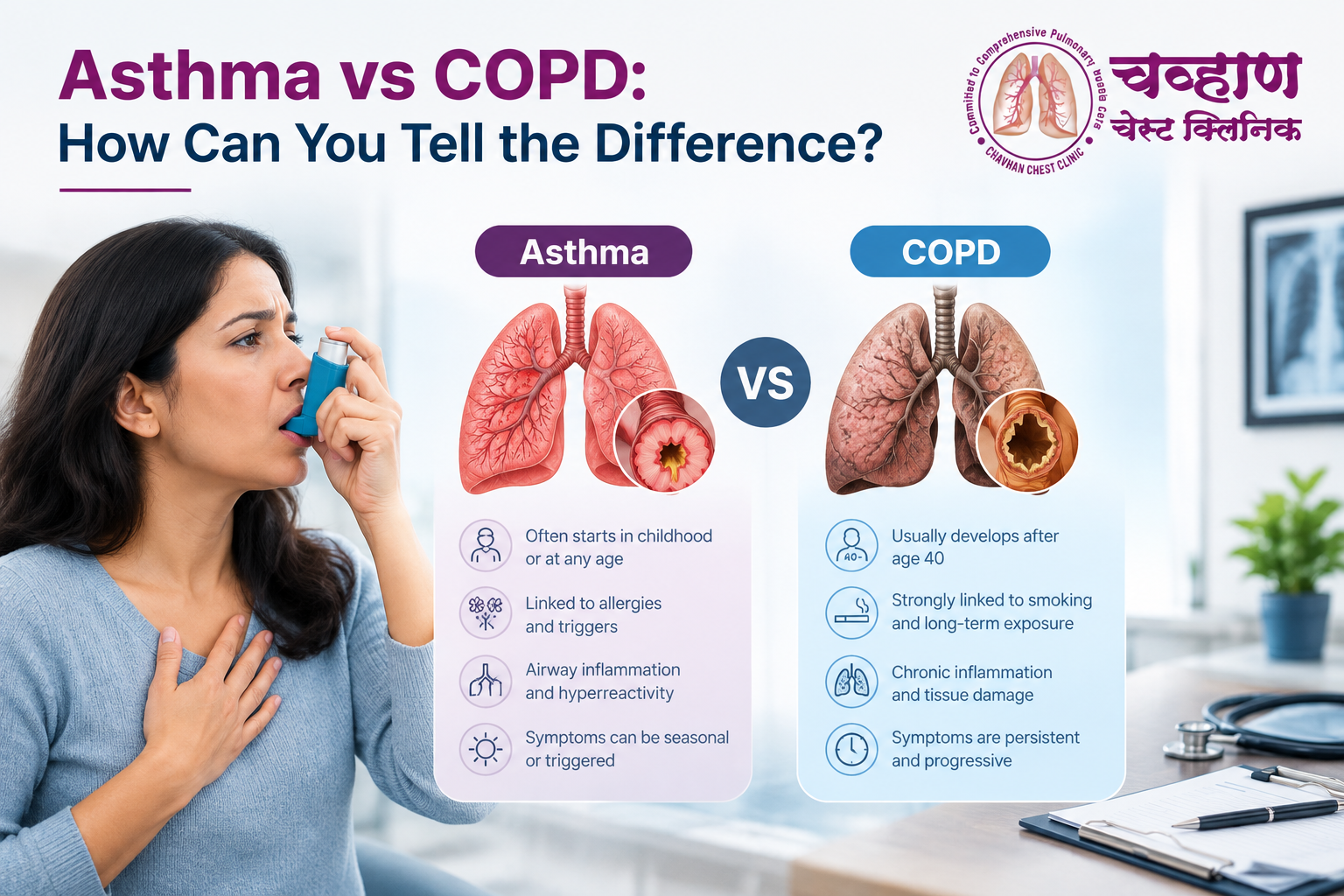
Asthma vs COPD: How Can You Tell the Difference?
A cough that won’t quit. Wheezing that comes out of nowhere. A tightness in your chest when you climb a flight of stairs you used to take without thinking. If any of this sounds familiar, you’ve probably searched some version of the asthma vs COPD difference, trying to figure out which one might explain what you’re feeling. It’s a fair question, and an important one, because asthma and chronic obstructive pulmonary disease (COPD) are two different lung conditions that can look remarkably similar on the surface but need very different long-term management.
Both are common causes of breathing problems in asthma and COPD in adults. Both can cause coughing, wheezing, chest tightness, and shortness of breath. And both can quietly affect your daily life, from climbing stairs to sleeping through the night, if left unaddressed. But asthma and COPD are not the same disease, and mistaking one for the other can delay the right treatment.
This article walks through the difference between asthma and COPD in plain language, covering how each condition typically develops, how their symptoms compare, how doctors reach a diagnosis, and what treatment generally involves. The goal is to help you understand your symptoms better and know when it’s time to see a pulmonologist, not to help you self-diagnose. Only a proper clinical evaluation can tell you which condition you actually have, or whether you have features of both.
Asthma and COPD Symptoms: Why They’re So Easy to Confuse
Asthma and COPD belong to the same broad family of conditions known as asthma and COPD lung disease, more formally called obstructive lung disease. In both, the airways become narrowed or inflamed, making it harder for air to move in and out of the lungs. This shared mechanism is exactly why asthma and COPD symptoms overlap so heavily:
● Cough – dry or with mucus, sometimes worse at night or early morning
● Wheezing – a whistling or squeaking sound while breathing
● Chest tightness – a sensation of pressure or constriction in the chest
● Shortness of breath – noticeable during activity, or in more advanced cases, even at rest
● Mucus production – more commonly a daily feature of COPD, though it can occur in asthma too, especially during flare-ups
Because these symptoms are so similar, it’s genuinely difficult to tell asthma vs COPD symptoms apart based on how you feel alone. Two people describing the exact same complaints, a persistent cough and breathlessness on exertion, could end up with completely different diagnoses once a doctor looks at the full picture. Overlap is the rule, not the exception, and individual experiences can vary quite a bit from what textbooks describe.
COPD vs Asthma: The Real Differences Once You Look Closer
While symptoms alone rarely settle the question of COPD vs asthma, several underlying patterns usually help separate the two conditions. None of these should be used in isolation to self-diagnose, but understanding them makes the conversation with your doctor much easier, and gives you a clearer asthma and COPD comparison to work from.
Age and Pattern of Onset
Asthma is often associated with childhood, but it can begin at any age, including well into adulthood. Adult-onset asthma is not unusual. COPD, on the other hand, tends to develop more gradually and is typically diagnosed in adults over 40, usually after years of exposure to a harmful irritant. Age alone doesn’t confirm a diagnosis, but it’s one piece of the puzzle your pulmonologist will consider.
Causes and Risk Factors
Asthma and COPD causes differ in important ways. Asthma is closely linked to allergic sensitivity and airway hyperresponsiveness, and often runs in families or appears alongside conditions like allergic rhinitis or eczema. COPD is more strongly associated with long-term exposure to lung irritants, most commonly cigarette smoke, but also biomass fuel smoke, occupational dust, chemical fumes, and air pollution.
It’s worth being clear about something many people assume incorrectly: not every smoker develops COPD, and not everyone with COPD has smoked. Genetic factors, air quality, occupational exposure, and even early-life lung development all contribute to asthma and COPD risk factors.
Smoking and Long-Term Exposure
This is one of the clearer distinguishing threads. A long history of smoking or occupational exposure to dust, chemicals, or fumes points more strongly toward COPD. Asthma can occur in people who have never smoked at all, and smoking is not considered a typical trigger for asthma in the way it’s a central risk factor for COPD.
Symptom Pattern: Variable vs Persistent
This is often the single most useful clue when weighing asthma or COPD as an explanation for your symptoms. Asthma symptoms tend to come and go, appearing as flare-ups or attacks triggered by something specific, with periods of relatively normal breathing in between. COPD symptoms, by contrast, tend to be more persistent day to day, and they generally progress slowly over months or years rather than appearing and disappearing.
That said, this isn’t an absolute rule. Some people with COPD also experience flare-ups (exacerbations), often triggered by respiratory infections, and some people with poorly controlled asthma can have near-daily symptoms too. This is exactly why the overall clinical picture matters more than any single symptom pattern.
Common Triggers
Asthma triggers often include allergens (dust mites, pollen, pet dander), cold air, exercise, strong odours, respiratory infections, and stress. COPD flare-ups are more frequently triggered by respiratory infections, air pollution, and ongoing exposure to smoke or irritants. Recognising your own triggers is useful information to share with your doctor, even though triggers alone don’t confirm a diagnosis.
Airflow Limitation and Reversibility
Both conditions involve airflow limitation, but the nature of that limitation differs. In asthma, the airway narrowing is often largely reversible, meaning lung function can return close to normal with treatment, especially between flare-ups. In COPD, the airflow limitation is usually only partially reversible because of structural changes and damage that build up in the airways and lung tissue over time. This doesn’t mean COPD treatment doesn’t help, it does, but the underlying damage generally doesn’t fully undo itself the way it can in asthma.
How to Tell Asthma From COPD: It’s About the Whole Picture, Not One Test or Symptom
A common question adults ask is simply, how do I know if it’s asthma or COPD? The honest answer is that you can’t reliably know this on your own, and trying to work out how to tell asthma from COPD based on symptoms, online checklists, or what a friend or relative experienced can lead you in the wrong direction.
Telling asthma and COPD apart is a clinical process that pulmonologists build from several sources of information together:
● Medical history – including when symptoms started, how they’ve changed over time, and whether they come and go or stay constant
● Smoking and exposure history – cigarette smoking, occupational exposures, indoor air pollution, and environmental factors
● Family and allergy history – a personal or family history of asthma, eczema, or allergic rhinitis can point toward asthma
● Physical examination – listening to your breathing, checking for signs of chronic lung disease, and assessing your general respiratory health
● Lung function testing – to measure how well air moves in and out of your lungs and whether that airflow limitation is reversible
No single symptom, and no single conversation, is enough. It’s the combination of your history, examination findings, and objective testing that allows a pulmonologist to arrive at an accurate asthma vs COPD diagnosis.
Spirometry: The Key Test in Asthma vs COPD Diagnosis
Spirometry is the main lung function test used to help distinguish between asthma and COPD, and it’s worth understanding in simple terms.
During spirometry, you breathe into a mouthpiece connected to a machine that measures how much air you can exhale and how quickly you can exhale it. Two of the key numbers this test produces are how much air you can forcefully blow out in the first second (FEV1) and the total amount you can exhale (FVC). Comparing these values helps your doctor assess whether there is airflow obstruction, and how significant it is.
What makes spirometry particularly useful is that it can also be repeated after you’re given a bronchodilator medicine, which relaxes and opens the airways. If your airflow improves significantly after the bronchodilator, that reversibility pattern leans more toward asthma. If the improvement is limited or absent, that pattern leans more toward COPD. In practice, doctors interpret these results alongside your full history rather than as a stand-alone verdict, and results can sometimes be less clear-cut, which is normal and simply means more clinical judgement is needed.
It’s important not to try to interpret your own spirometry numbers or compare them to numbers you find online. Reference ranges vary by age, height, sex, and the specific equipment used, and your pulmonologist is best placed to explain what your individual results mean.
Other Investigations
Depending on your symptoms and what your doctor finds during the initial assessment, additional tests may sometimes be recommended. These can include chest X-rays or other imaging, blood tests, allergy testing, or more detailed lung function studies. Not everyone needs every test, and the right combination depends entirely on your individual clinical picture. Your pulmonologist will decide what’s appropriate based on your specific symptoms and history rather than following a fixed checklist for everyone.
Asthma vs COPD Treatment: Different Conditions, Different Approaches
Once a diagnosis is clearer, asthma vs COPD treatment, while sharing some common ground, generally differs in emphasis.
For asthma, treatment usually centres around inhaled medicines that reduce airway inflammation and relax the airway muscles, along with identifying and avoiding personal triggers wherever possible. With consistent treatment and trigger management, many people with asthma achieve good day-to-day control.
For COPD, treatment also relies heavily on inhaled medicines to ease breathlessness and reduce flare-ups, but equally important is addressing the underlying exposure, which usually means smoking cessation for those who currently smoke, and reducing exposure to occupational or environmental irritants where relevant. Pulmonary rehabilitation, a structured programme of exercise training and education, is often recommended for appropriate COPD patients to help improve breathing capacity and quality of life. Vaccinations against respiratory infections, such as influenza and pneumococcal disease, are also frequently advised for people with COPD, since infections can trigger serious flare-ups.
For both conditions, regular follow-up with a pulmonologist matters. Lung conditions can change over time, and treatment plans often need adjusting based on how well symptoms are controlled and how lung function evolves.
This article is meant to give you a general understanding of how these conditions are managed, not to serve as medical advice. Please do not start, stop, or change any medication without consulting your doctor, since the right inhaler, dosage, and combination of treatments depends entirely on your specific diagnosis and health status.
When Someone Has Features of Both
Some adults genuinely have characteristics of both asthma and COPD, sometimes referred to clinically as asthma-COPD overlap. This tends to happen more often in older adults, particularly those with a history of both allergic asthma and significant smoking or irritant exposure. If this applies to you, it doesn’t mean the diagnostic process has failed, it simply means your case needs a more nuanced clinical assessment, and your treatment plan will likely need to address both components. This is another reason self-diagnosis isn’t reliable here. Overlap cases are exactly where an experienced pulmonologist’s judgement matters most.
When Should You See a Pulmonologist?
You don’t need to wait until symptoms become severe before seeking a proper evaluation. It’s worth booking a consultation with a pulmonologist if you notice:
● A cough that has lasted more than a few weeks, especially if it’s persistent or productive
● Wheezing or a whistling sound when you breathe
● Shortness of breath during activities that didn’t used to leave you breathless
● Chest tightness that recurs
● Breathing symptoms that are affecting your sleep, work, or daily routine
● A history of smoking or long-term exposure to dust, fumes, or air pollution along with any of the above
Getting an accurate diagnosis early makes a real difference. It allows the right treatment to begin sooner, helps prevent unnecessary flare-ups, and in the case of COPD, can help slow further decline in lung function.
Warning Signs That Need Urgent Medical Attention
While most breathing symptoms can be evaluated through a routine consultation, certain signs point to a medical emergency and should never wait for a scheduled appointment. Seek immediate medical care if you or someone near you experiences:
● Severe difficulty breathing or breathlessness that is rapidly worsening
● Difficulty speaking in full sentences because of breathlessness
● Bluish discolouration of the lips, face, or fingertips
● Confusion, drowsiness, or reduced alertness
● Chest pain along with breathing difficulty
● A rescue inhaler or usual medication not providing relief as it normally would
These signs can indicate a serious asthma attack, a severe COPD flare-up, or another urgent respiratory problem, and require emergency evaluation without delay.
Frequently Asked Questions
Can you have asthma and COPD at the same time?
Yes. Some adults, particularly older adults with a history of both allergic asthma and long-term smoking or irritant exposure, have features of both conditions. This is usually assessed and managed by a pulmonologist rather than diagnosed at home.
What is the main difference between asthma and COPD?
Broadly, asthma symptoms tend to be variable and often reversible with treatment, while COPD symptoms tend to be persistent and only partially reversible. But this is a general pattern, not a rule you can apply to your own case without testing.
Does COPD always mean someone smoked?
No. Smoking is the most common risk factor for COPD, but long-term exposure to biomass fuel smoke, occupational dust, chemical fumes, and air pollution can also cause it, even in people who never smoked.
Can asthma start in adulthood?
Yes. While asthma is often linked to childhood, adult-onset asthma is common and should be considered in anyone developing new respiratory symptoms, regardless of age.
What test is used to diagnose asthma vs COPD?
Spirometry, a breathing test that measures airflow before and after a bronchodilator, is the main tool used. Results are interpreted alongside your medical history, symptom pattern, and examination findings, not in isolation.
Is it possible to tell asthma and COPD apart just from symptoms?
Not reliably. Cough, wheezing, chest tightness, and breathlessness appear in both conditions. An accurate diagnosis needs a clinical evaluation and lung function testing rather than a symptom checklist.
The Bottom Line
Asthma and COPD are two distinct lung conditions that happen to share a lot of surface-level symptoms, which is exactly what makes self-diagnosis so unreliable. Age of onset, smoking and exposure history, whether symptoms come and go or stay constant, and how your airways respond during lung function testing all contribute to the real answer. Getting that answer right isn’t just an academic exercise, it directly shapes which treatment will actually help you breathe easier and protect your lung health over the years ahead.
If you’ve been living with persistent cough, wheezing, chest tightness, or shortness of breath and haven’t had a clear answer yet, a proper clinical evaluation is the next right step. Dr. Vinod Chavhan, a Consultant Pulmonologist based in Navi Mumbai, evaluates adults with respiratory symptoms and lung conditions, including asthma and COPD, using a detailed history, physical examination, and appropriate lung function testing to help reach an accurate diagnosis and build a treatment plan suited to your individual case.
