Bronchoscopy Treatment: Purpose, Procedure, Benefits, Risks, and Recovery
Bronchoscopy treatment is an advanced pulmonary procedure used to examine and manage conditions affecting the airways and lungs. It allows doctors to directly visualize the bronchial tubes, identify abnormalities, and collect tissue or fluid samples for accurate diagnosis. Unlike many surgical procedures, lung bronchoscopy is minimally invasive and provides real-time insights into airway health.
Widely used in evaluating infections, chronic respiratory disorders, airway blockages, and cancers, bronchoscopy treatment plays a vital role in modern respiratory care. When imaging tests such as chest X-rays or CT scans do not provide clear answers, a bronchoscopy test helps doctors look inside the lungs for a precise diagnosis.
As explained by Dr. Vinod B. Chavhan, bronchoscopy helps clinicians make accurate treatment decisions while avoiding unnecessary invasive surgery. Early and timely use of the bronchoscopy procedure can significantly improve patient outcomes.
What Is Bronchoscopy Treatment?
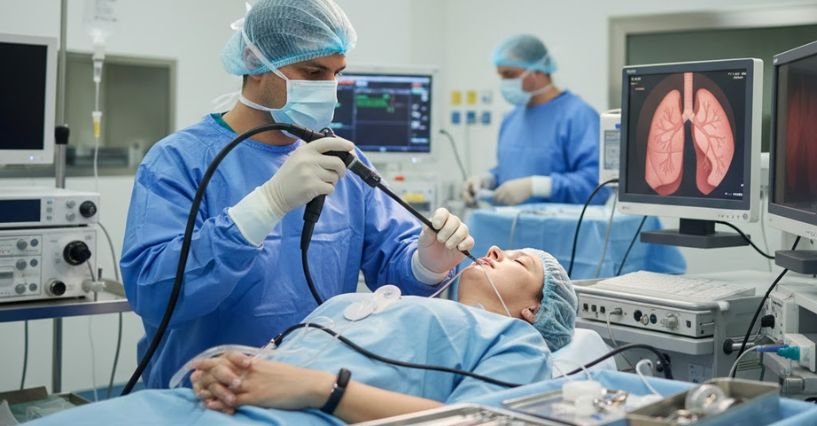
Bronchoscopy treatment involves inserting a bronchoscope—a thin, flexible tube equipped with a light and camera—through the nose or mouth into the airways. The device passes through the throat into the trachea and bronchial tubes, allowing direct visualization of the respiratory tract.
This lung bronchoscopy procedure helps doctors detect inflammation, tumors, infections, bleeding, or structural abnormalities inside the airways.
There are two main purposes of bronchoscopy treatment:
- Diagnostic Bronchoscopy Test – Used to identify disease, collect biopsy samples, remove mucus plugs, or obtain lung fluid for laboratory analysis.
- Therapeutic Bronchoscopy Procedure – Used to treat airway blockages, remove foreign bodies, stop bleeding, or place stents.
Because it provides direct visualization, the bronchoscopy test improves diagnostic accuracy and reduces the need for exploratory surgery.
Why Is Bronchoscopy Done?
Doctors recommend bronchoscopy treatment when imaging tests alone cannot explain lung symptoms. If a patient continues to experience respiratory problems despite normal test results, a bronchoscopy procedure may be necessary.
The bronchoscopy test helps evaluate:
- Airway health
- Disease severity
- Infection source
- Tumor presence
- Disease progression
It also allows doctors to collect tissue samples (biopsy), remove secretions, and identify bacteria, viruses, or fungi causing infections.
Symptoms That May Require Bronchoscopy
A bronchoscopy treatment may be advised if a patient experiences:
- Persistent or unexplained cough
- Shortness of breath or breathing difficulty
- Wheezing not responding to treatment
- Recurrent lung infections
- Blood in sputum (hemoptysis)
- Abnormal chest X-ray or CT scan findings
- Suspected airway obstruction
When these symptoms remain unexplained, a bronchoscopy test procedure provides valuable diagnostic clarity.
Diagnostic and Therapeutic Goals
The goals of bronchoscopy treatment include:
- Identifying airway blockages
- Detecting inflammation or scarring
- Diagnosing infections
- Confirming chronic lung conditions
- Collecting biopsy samples
- Removing foreign objects
- Managing airway bleeding
Conditions Diagnosed or Treated Using Bronchoscopy
Bronchoscopy for lung problems is widely used in diagnosing both cancerous and non-cancerous conditions.
Cancer-Related Applications
Bronchoscopy plays a critical role in lung cancer diagnosis and staging.
Detection of Lung Tumors
A bronchoscopy test allows doctors to visually inspect suspicious masses inside the airways.
Bronchoscopy for Lung Cancer Biopsy
During bronchoscopy for lung cancer, doctors collect tissue samples from tumors. These samples are examined under a microscope to confirm cancer type and stage.
Assessment of Airway Involvement
The bronchoscopy procedure helps determine whether cancer has spread into the bronchial passages.
Early detection through bronchoscopy treatment significantly improves treatment planning and survival rates.
Non-Cancer Conditions
Bronchoscopy for lung problems is also used to diagnose and treat:
- Pneumonia
- Tuberculosis
- Fungal infections
- Asthma complications
- COPD flare-ups
- Interstitial lung disease
- Foreign body aspiration
- Airway narrowing (stenosis)
- Scar tissue formation
- Chronic inflammation
In many cases, bronchoscopy treatment identifies infections that imaging tests cannot clearly detect.
Types of Bronchoscopy
There are two main types of bronchoscopy procedures.
Flexible Bronchoscopy
Flexible bronchoscopy is the most commonly performed bronchoscopy treatment. It uses a thin, bendable tube that easily navigates through the airways.
It is typically performed as an outpatient bronchoscopy test procedure under local anesthesia and mild sedation.
Flexible bronchoscopy is used for:
- Biopsy collection
- Bronchoalveolar lavage (fluid washing)
- Secretion removal
- Infection diagnosis
- Evaluating airway inflammation
Because it is minimally invasive, recovery is usually quick.
Rigid Bronchoscopy
Rigid bronchoscopy uses a straight, metal tube and is performed under general anesthesia.
Doctors use rigid bronchoscopy treatment for:
- Removing large obstructions
- Controlling airway bleeding
- Removing foreign objects
- Placing airway stents
- Treating severe airway narrowing
Rigid bronchoscopy is often used in complex airway interventions.
How Is the Bronchoscopy Procedure Performed?
Understanding the bronchoscopy procedure helps patients feel more confident and prepared.
Pre-Procedure Preparation
Before the bronchoscopy test:
- The doctor reviews medical history
- Blood tests may be performed
- Certain medications may be stopped
- The patient must fast for 6–8 hours
- Dentures or loose dental work are removed
Proper preparation ensures safety during bronchoscopy treatment.
Step-by-Step Bronchoscopy Procedure
- The patient receives local anesthesia to numb the throat.
- Sedation is administered to ensure comfort.
- The bronchoscope is gently inserted through the nose or mouth.
- The device passes into the trachea and bronchial tubes.
- The doctor visually examines the airways.
- Biopsy samples or fluid may be collected.
- If needed, therapeutic interventions are performed.
The bronchoscopy procedure usually takes 20–45 minutes.
Duration and Monitoring
During the bronchoscopy test procedure:
- Oxygen levels are continuously monitored.
- Heart rate and blood pressure are tracked.
- Patients remain under supervision after completion.
Most patients go home the same day.
Is Bronchoscopy Painful or Safe?
Many patients ask, “Is bronchoscopy safe?” The answer is yes when performed by experienced specialists.
The bronchoscopy treatment is generally painless because sedation and local anesthesia are used. Patients may feel mild pressure or temporary throat discomfort.
Bronchoscopy is considered a safe procedure with a low complication rate. Medical teams monitor patients closely to reduce risks.
Benefits of Bronchoscopy Treatment
Bronchoscopy treatment offers several important advantages in diagnosing and managing lung and airway conditions. Because it allows doctors to directly see inside the airways, it provides accurate, real-time information that imaging tests alone may not reveal. Below are the key benefits explained in detail:
1. Accurate Diagnosis of Lung Diseases
One of the biggest benefits of bronchoscopy treatment is precise diagnosis. The bronchoscopy procedure allows doctors to examine the trachea and bronchial tubes directly using a camera. If they notice abnormal tissue, inflammation, tumors, or infection, they can immediately collect biopsy samples or fluid for laboratory testing.
This direct visualization improves diagnostic accuracy and helps avoid guesswork. Conditions such as chronic infections, interstitial lung disease, airway scarring, and unexplained lung abnormalities can be identified more clearly with a bronchoscopy test.
2. Early Detection of Lung Cancer
Bronchoscopy plays a critical role in the early detection of lung cancer. When imaging scans show suspicious lung nodules or airway masses, bronchoscopy for lung cancer allows doctors to examine the area closely and obtain tissue samples.
Early diagnosis increases treatment options and improves survival rates. Detecting lung cancer at an early stage allows timely surgery, chemotherapy, radiation, or targeted therapy, leading to better outcomes.
3. Identification of Infections
Many lung infections cannot be fully diagnosed with chest X-rays alone. Bronchoscopy treatment allows doctors to collect mucus, lung fluid (bronchoalveolar lavage), or tissue samples to identify bacterial, viral, or fungal infections.
This is especially useful in patients with:
- Recurrent pneumonia
- Tuberculosis
- Fungal infections
- Weakened immune systems
Accurate identification ensures patients receive the correct antibiotics or antifungal medications without delay.
4. Minimally Invasive Approach
Unlike open lung surgery, the bronchoscopy procedure is minimally invasive. Doctors insert a thin, flexible bronchoscope through the nose or mouth without making any large cuts or incisions.
Because of this:
- There is less pain
- Recovery is faster
- The risk of complications is lower
- Hospital stays are shorter
Most bronchoscopy treatments are performed as outpatient procedures.
5. Faster Recovery Compared to Surgery
Since bronchoscopy does not involve major surgery, patients recover quickly. Most individuals can return home the same day and resume normal activities within 24 to 48 hours.
There is no large surgical wound, no stitches, and minimal discomfort. This makes bronchoscopy a preferred option for both diagnosis and certain treatments.
6. Simultaneous Diagnosis and Treatment
Another major benefit of bronchoscopy treatment is that it can serve both diagnostic and therapeutic purposes in a single session.
During the same bronchoscopy procedure, doctors can:
- Remove mucus plugs
- Stop airway bleeding
- Remove foreign bodies
- Place airway stents
- Clear obstructions
This reduces the need for multiple procedures and speeds up patient care.
7. Reduced Hospital Stay
Because bronchoscopy treatment is minimally invasive and often done under local anesthesia with sedation, patients usually require only short observation periods. Many cases do not require overnight admission.
Shorter hospital stays:
- Reduce medical costs
- Lower infection risk
- Improve patient comfort
8. Improved Treatment Planning
Bronchoscopy provides detailed visual and laboratory information. Biopsy and fluid analysis results help doctors confirm diagnoses and determine disease severity.
This information helps in:
- Choosing the right medication
- Planning surgery if needed
- Deciding chemotherapy or radiation therapy
- Monitoring disease progression
Accurate data leads to personalized treatment plans and better long-term outcomes.
Risks and Possible Complications of Bronchoscopy
Although bronchoscopy treatment is safe, it carries some risks.
Common Bronchoscopy Side Effects
- Sore throat
- Mild cough
- Temporary hoarseness
- Slight fever
- Minor bleeding after biopsy
These bronchoscopy side effects usually resolve within a few days.
Rare Complications
Rare but serious complications include:
- Infection
- Lung collapse (pneumothorax)
- Heavy bleeding
- Breathing difficulties
- Reaction to sedation
Doctors take precautions to minimize these risks.
Recovery After Bronchoscopy Treatment
Recovery from bronchoscopy treatment is generally quick.
Immediate Recovery
After the bronchoscopy procedure:
- Patients remain under observation for 1–2 hours.
- Throat numbness fades gradually.
- Eating and drinking are avoided until sensation returns.
Home Care After Bronchoscopy
Patients should:
- Avoid eating until numbness disappears.
- Rest for 24 hours.
- Avoid driving on the same day.
- Follow medication instructions.
- Contact the doctor if severe symptoms occur.
Most patients resume normal activities within 24–48 hours.
Understanding Bronchoscopy Results
In many cases, doctors share visual findings immediately after the bronchoscopy test.
However, biopsy results may take a few days.
Bronchoscopy treatment results help:
- Confirm lung cancer
- Identify infections
- Diagnose chronic lung diseases
- Determine severity of airway damage
- Guide further treatment plans
Early and accurate bronchoscopy findings improve patient outcomes.
Frequently Asked Questions
Is bronchoscopy used only for lung cancer?
No. Bronchoscopy treatment is used for infections, airway narrowing, chronic lung disease, and foreign body removal in addition to bronchoscopy for lung cancer.
How long does bronchoscopy recovery take?
Most patients recover within 24–48 hours after the bronchoscopy procedure.
Can bronchoscopy detect infections?
Yes. The bronchoscopy test procedure allows doctors to collect fluid samples to identify bacterial, viral, or fungal infections.
Is bronchoscopy safe for elderly patients?
Yes. When performed by experienced specialists, bronchoscopy treatment is safe for elderly patients, provided medical conditions are properly managed.
Conclusion
Bronchoscopy treatment is a reliable and effective method for diagnosing and managing a wide range of lung conditions. From bronchoscopy for lung cancer to bronchoscopy for lung problems such as infections and airway narrowing, this procedure plays a critical role in respiratory medicine.
The bronchoscopy procedure provides direct airway visualization, enabling accurate diagnosis without invasive surgery. It is safe, minimally invasive, and offers faster recovery compared to traditional surgical methods.
Early diagnosis through bronchoscopy treatment supports better treatment outcomes, timely intervention, and improved quality of life for patients experiencing respiratory symptoms.
