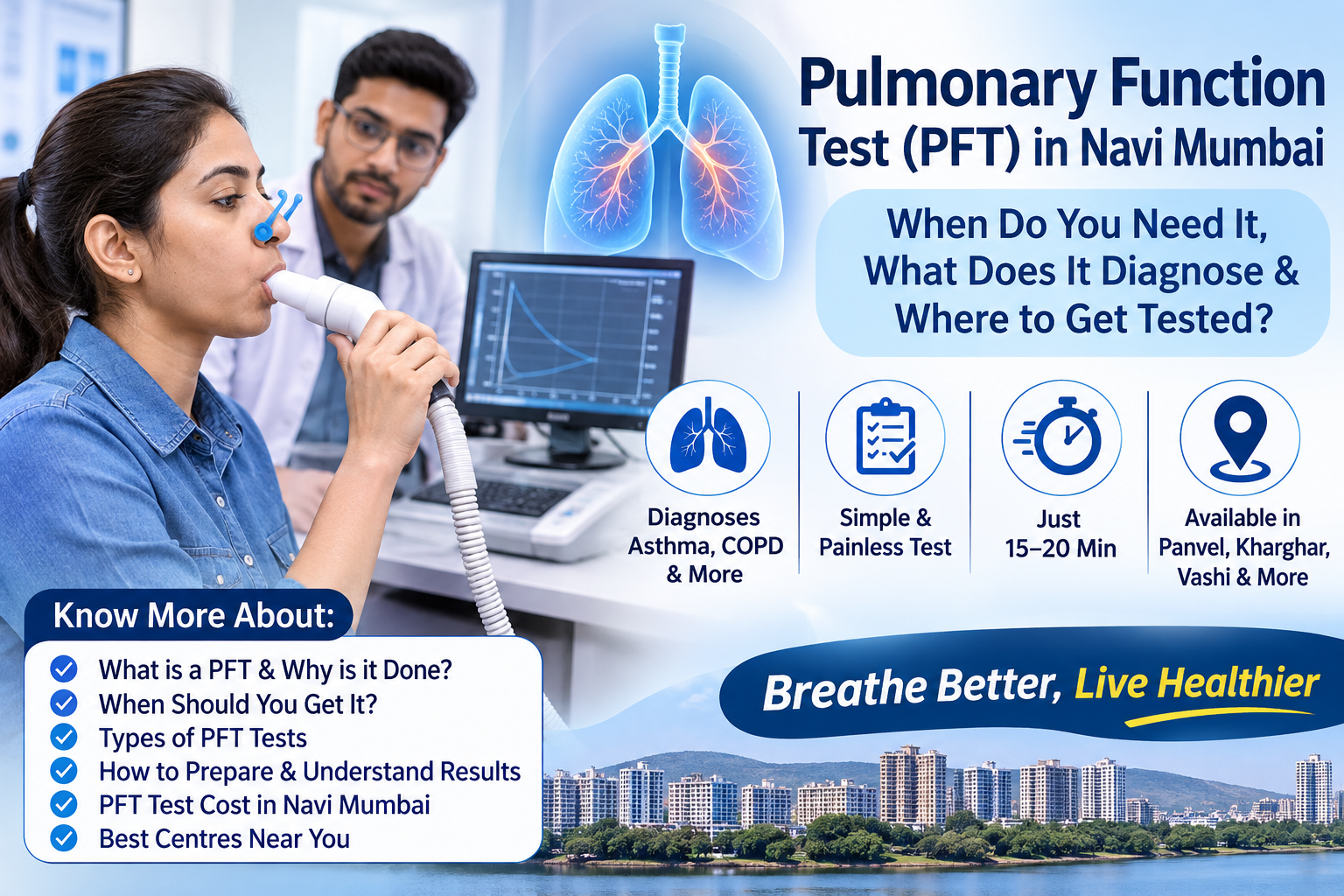
Pulmonary Function Test (PFT) in Navi Mumbai: When Do You Need It, What Does It Diagnose & Where to Get Tested?
If you have been coughing for weeks, running out of breath on the stairs or hearing a whistle in your chest at night, your doctor may suggest a Pulmonary Function Test. It is a simple, painless breathing test that measures how much air your lungs can hold, how fast you can blow it out and how well oxygen passes into your blood. Instead of guessing, your doctor gets real numbers to work with.
Many people in Kharghar, Vashi, Belapur and Panvel start by looking for a PFT Centre in Navi Mumbai, and then wonder what the test involves and what it will cost. This guide answers those questions in plain language.
What Is a Pulmonary Function Test (PFT)?
A PFT is not one single test. It is a group of breathing tests, and each one looks at a different part of lung function. Together they show how well air moves in and out, how much air the lungs hold, and how efficiently oxygen crosses into the blood.
The simplest and most common of these is spirometry. If you look for a Spirometry Test in Navi Mumbai, this is usually what you will find. It is quick and needs only a handheld sensor connected to a computer.
Three numbers come up again and again in a PFT report:
| Measure | What it means in simple words |
| FVC (forced vital capacity) | The total air you can blow out after a full breath in |
| FEV1 | How much of that air you blow out in the first second |
| FEV1/FVC ratio | The share of your air you can empty in one second. A low ratio points to narrowed airways |
Why Is a Pulmonary Function Test Done?
The honest answer to why is a pulmonary function test done is that symptoms alone can mislead. Cough, breathlessness and chest tightness feel much the same whether they come from asthma, smoking-related damage, an old infection or even a heart problem. A PFT gives your doctor an objective starting point.
Doctors use it to:
- Find out whether the airways are narrowed, or the lungs are stiff and small
- Judge how severe a lung problem is
- Check whether an inhaler or other treatment is working
- Track changes over months or years
- Assess lung health before certain surgeries
When Should You Get a PFT Test?
Most people ask when should I get a PFT test after a cough or breathing trouble refuses to settle. A single cough after a cold does not need one. A symptom that lasts or keeps returning usually does. These are the common situations:
- A cough lasting more than 8 weeks
- Wheezing, especially at night or early in the morning
- Breathlessness that is new, getting worse or limiting daily routines
- Chest tightness during exercise
- Frequent chest infections
Who Needs a Lung Function Test?
Not everyone with a lung problem has obvious symptoms, which is why people also ask who needs a lung function test. Those at higher risk include:
- Long-term smokers, particularly over 40 to 45
- People exposed to dust, fumes or smoke at work, or to cooking-fuel smoke at home
- Anyone with a past history of tuberculosis or lung infection
- People with a family history of lung disease
- Patients lined up for chest or major surgery
What Diseases Can a PFT Test Help Diagnose?
A PFT is one of several tests to diagnose lung disease, along with a chest X-ray, CT scan and blood tests. It shows how your lungs behave, not what is causing the problem. That is why your doctor reads it together with your symptoms and examination.
PFT Test for Asthma
A PFT Test for Asthma can show airway narrowing that improves after an inhaler is given during the test. That improvement is a useful clue. Between attacks, however, the results can look completely normal, so a normal report does not always rule asthma out.
PFT Test for COPD
A PFT Test for COPD looks closely at the FEV1/FVC ratio after a bronchodilator. A ratio that stays below 0.70 is the widely used marker of airflow obstruction in COPD. Your pulmonologist makes the final diagnosis by combining it with your history and symptoms.
Lung Function Test for Chronic Cough
A Lung Function Test for Chronic Cough helps separate lung causes from non-lung ones. Some people with a long dry cough have a hidden form of asthma that shows up on testing. Others have normal results, and the cough turns out to be linked to reflux, allergies or sinus drainage.
Lung Test for Shortness of Breath
A Lung Test for Shortness of Breath helps answer one basic question: is the problem in the lungs, or somewhere else? Breathlessness can also come from the heart, anaemia or anxiety. A normal PFT points the search in another direction.
What Are the Different Types of Pulmonary Function Tests?
Not everyone needs every test. Your doctor chooses based on your symptoms and on what still needs to be answered.
Spirometry Test
You take a deep breath and blow out as hard and fast as you can into a mouthpiece. This is repeated a few times to check consistency. It is often done again after an inhaler to see how the airways respond.
Lung Volume Test
This measures the total air your lungs can hold, including the air that stays behind after you breathe out. If you wonder how to check lung capacity accurately, this is the reliable route. Home gadgets cannot replace a supervised measurement. It is usually done in a small booth called a body plethysmograph, or with a gas dilution method.
Diffusion Capacity Test (DLCO)
You breathe in a tiny, safe amount of carbon monoxide, hold your breath briefly and then breathe out. The test shows how smoothly oxygen passes from the air sacs into the blood. It helps in conditions such as pulmonary fibrosis and blood vessel problems in the lungs.
How Is a Pulmonary Function Test Performed?
A breathing problem test can sound alarming, but the process is straightforward. You sit comfortably, a clip goes on your nose, and a trained technician coaches you through each breath.
- You breathe normally through a mouthpiece.
- You take the deepest breath you can.
- You blow out hard and fast for as long as you can, until the technician tells you to stop.
- This is repeated until the readings are consistent.
- You may be given an inhaler and repeat the test after a few minutes.
Basic spirometry usually takes around 15 to 20 minutes. A fuller PFT with lung volumes and DLCO takes longer, so ask the centre for the expected time when you call.
Most people feel fine. A little dizziness or a coughing spell after hard blowing is common and passes quickly. Tell the technician if you have had a recent heart problem, chest or abdominal surgery, or an active chest infection.
How to Prepare for a PFT Test?
Preparation is simple, and a few small things make the result more accurate:
- Ask your doctor whether to take or hold your regular inhalers on the day. Do not stop any medicine on your own.
- Do not smoke before the test.
- Avoid a heavy meal just before it. You do not need to fast.
- Wear loose, comfortable clothes.
- Skip vigorous exercise beforehand.
- Carry your prescription and any older reports.
When you are ready to arrange it, a PFT Test Appointment is usually quick to get at a hospital or diagnostic centre. Ask whether a doctor’s prescription is needed and whether a pulmonologist reviews the report.
How to Understand PFT Test Results?
A Pulmonary Function Test report compares your numbers with predicted values based on your age, sex and height. Your results are shown as a percentage of that expected value. Many reports treat 80 percent or above as within the normal range, but your doctor interprets the full picture.
| Pattern | What it may suggest |
| Low FEV1/FVC ratio | Obstruction, as in asthma or COPD |
| Low FVC with a normal ratio | Possible restriction. Lung volumes are needed to confirm |
| Big improvement after the inhaler | Reversible airway narrowing, as seen in asthma |
| Low DLCO | A problem with gas exchange |
A PFT alone does not confirm every lung disease. Always discuss your report with your doctor.
What Is the PFT Test Price in Navi Mumbai?
The PFT Test Price in Navi Mumbai is not one fixed number. Online listing sites show a very wide spread, from a few hundred rupees to a few thousand. These figures are not the same as what a particular centre will charge, so always confirm directly.
The Pulmonary Function Test Cost mainly depends on which tests you need. Basic spirometry sits at the lower end, while adding lung volumes and DLCO raises the fee. Hospital versus standalone lab, and whether a doctor’s review is included, also change the amount.
The Spirometry Test Cost is usually the most modest part of the range, particularly when it is done without a bronchodilator. Repeating it after an inhaler adds time and may add to the fee.
When you compare the Lung Function Test Price between centres, do not look at the number alone. Check what is included: the specific tests, the report format and whether a pulmonologist reads it. Ask your insurer separately about coverage.
Where to Get a Pulmonary Function Test in Navi Mumbai?
Searching for a Pulmonary Function Test Near Me brings up multispeciality hospitals with chest or pulmonology departments, diagnostic chains and individual chest clinics. Facilities differ, so confirm the exact tests offered before you travel.
If you type Lung Test Near Me, expect plenty of results that are not true PFT services. Some listings offer only a basic handheld screening. Ask whether the centre does a full lab-grade measurement.
Anyone looking for a Spirometry Centre Near Me should ask whether the machine is calibrated regularly and whether a trained technician coaches every effort. Technique matters more than the brand of the device.
PFT Test in Panvel
For a PFT Test in Panvel, start with the multispeciality hospitals and diagnostic centres in and around New Panvel. At least one diagnostic group lists PFT among its services with branches in this belt, but listings change. Call first to check availability.
PFT Test in Kharghar
Residents looking for a PFT Test in Kharghar have hospitals and labs within the node, which keeps travel short for someone with breathing difficulty. Confirm that the centre offers the specific test your doctor has written.
PFT Test in Vashi
A PFT Test in Vashi suits people travelling in from Mumbai, since Vashi is the easiest entry point by road and rail. Confirm by phone that the centre offers full PFT and not only basic screening before you go.
How to Choose the Right PFT Testing Centre?
Pick a centre you would be comfortable returning to, because follow-up tests are common. Look for:
- Well-maintained, regularly calibrated equipment
- Trained technicians who coach you through each effort
- A pulmonologist or physician who reviews and signs the report
- Clear preparation instructions given in advance
- A readable report with graphs, predicted values and the post-inhaler comparison
- Reasonable appointment availability and easy access
When you browse a PFT Test Centre Near Me list, call two or three places and ask them the same questions. The answers tell you a lot about how seriously each one takes accuracy.
Before you Book PFT Test Near Me through an app or website, confirm the centre’s exact address, test timings and whether the report is given the same day. Apps sometimes list tests that a centre does not actually perform.
When Should You See a Doctor Urgently?
Do not wait for a PFT if you have severe breathlessness at rest, blue lips, chest pain, or you are coughing up blood. Go to an emergency department straight away.
For everything else, looking after your lungs starts with understanding them. Looking to understand your lung health? Contact a qualified diagnostic centre in Navi Mumbai to enquire about PFT testing and appointment availability.
Frequently Asked Questions About PFT
When should I get a PFT test?
Get one when a cough lasts beyond 8 weeks, or when wheezing, chest tightness or breathlessness keeps returning or limits your routine. Long-term smokers and people with workplace dust exposure may also be advised to test even without symptoms. Your doctor decides based on your history.
Is a PFT test painful?
No. It involves breathing into a mouthpiece with a clip on your nose. Some people feel briefly dizzy or cough after blowing hard, which passes within minutes. Tell the technician if you feel unwell so they can pause.
How long does a pulmonary function test take?
Basic spirometry usually takes about 15 to 20 minutes. A fuller PFT with lung volumes and DLCO takes longer. Time also depends on whether you repeat the test after an inhaler. The centre can give you an estimate when you book.
Can a PFT test detect asthma?
It can support the diagnosis by showing airway narrowing that improves after an inhaler. But results can be normal between attacks, so a normal report does not completely exclude asthma. Doctors combine the result with symptoms, history and sometimes repeat testing.
Can a PFT test detect COPD?
Yes. Spirometry is the key test for COPD. A ratio of FEV1 to FVC that stays below 0.70 after an inhaler indicates airflow obstruction. Your pulmonologist confirms the diagnosis by combining this with symptoms and smoking or exposure history.
Is spirometry the same as PFT?
Not exactly. Spirometry is one part of PFT and measures how much air you blow out and how fast. A complete PFT may also include lung volumes and DLCO, which assess total lung size and oxygen transfer. Your doctor orders what is needed.
Do I need to fast before a PFT test?
No fasting is required. Avoid a heavy meal right before the test, because a full stomach can make deep breathing uncomfortable. Do not smoke beforehand, and ask your doctor whether to take your regular inhalers that day.
What is a normal FEV1 value?
There is no single normal number. FEV1 is compared with a predicted value for your age, sex and height, and many reports treat 80 percent or more of predicted as normal. A healthy FEV1/FVC ratio is generally above 0.70.
What is the cost of a PFT test in Navi Mumbai?
Listing sites show a wide range, from a few hundred rupees to a few thousand. Basic spirometry costs less than a full test with lung volumes and DLCO. Hospital charges also differ from standalone labs, so ask each centre what the fee includes.
Where can I book a PFT test near me?
Check hospitals with chest departments and diagnostic centres in your area, whether Panvel, Kharghar, Vashi or elsewhere. Call before visiting to confirm they perform full PFT. Ask about timings, prescription requirements and whether a doctor reviews the report.
Can children and older adults take a PFT?
Yes, if they can follow breathing instructions. Children can usually manage it from around 5 or 6 years of age. Older adults can also be tested, though frailty or poor effort can affect accuracy. A trained technician makes a real difference.
Can I take the test if I have a cold or fever?
It is better to postpone. An acute infection can lower results and give a misleading picture. Check with your doctor, who may suggest testing once you have recovered, unless there is an urgent reason to go ahead.
Does a normal result rule out lung disease?
Not always. Conditions such as asthma can look normal between flare-ups, and some early lung problems show up only on other tests. If symptoms continue despite a normal PFT, your doctor may advise a chest X-ray, CT scan or repeat testing.
