
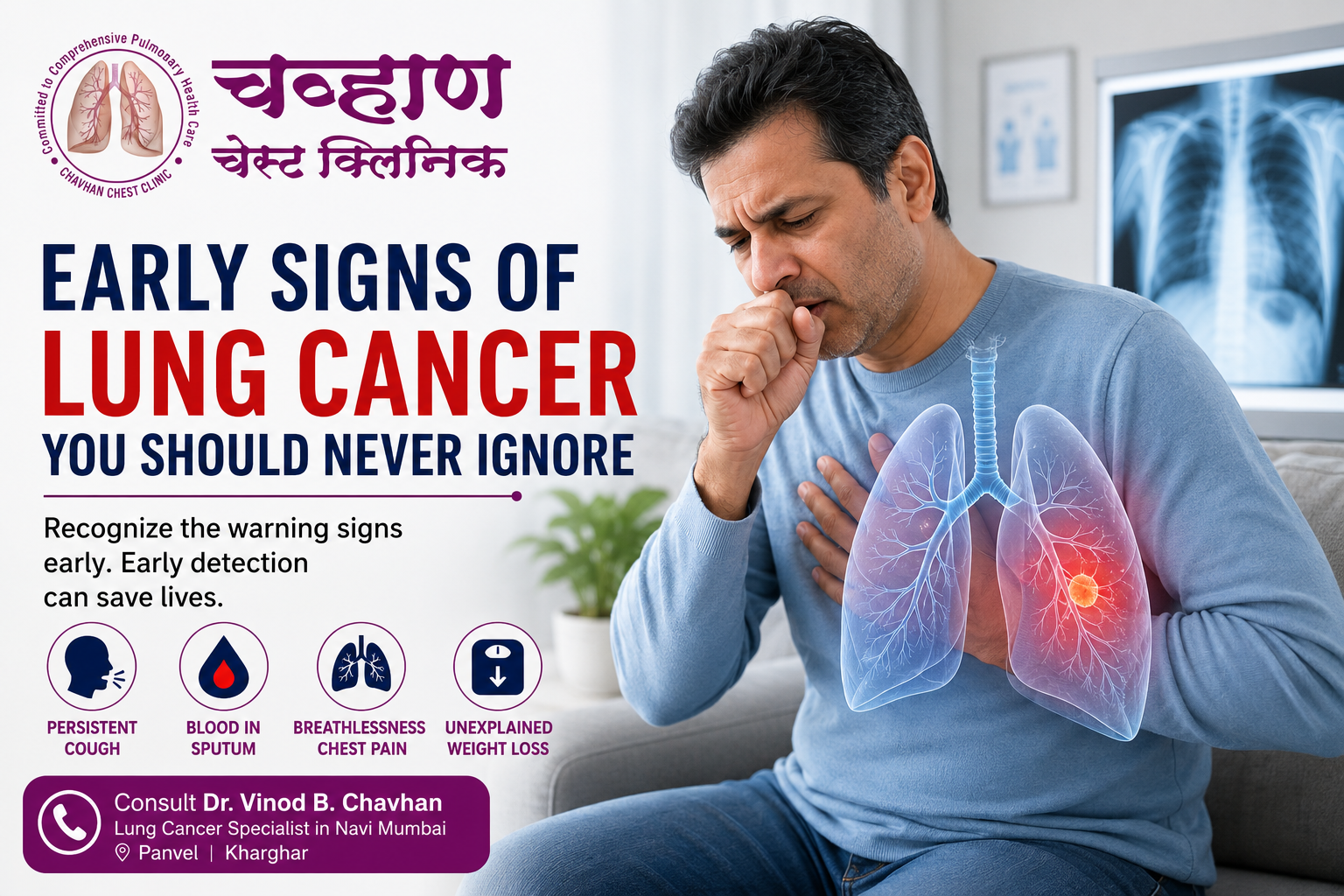
Early Signs of Lung Cancer You Should Never Ignore
Most people in India who are later diagnosed with lung cancer had one thing in common — they waited too long.
A cough that started “months ago.” Chest pain they assumed was acidity. Breathlessness they blamed on the heat or pollution. By the time they visited a doctor, the cancer was already at Stage 3 or 4, which is when treatment becomes much harder.
This is the single biggest problem with lung cancer symptoms: they look ordinary at first. They feel like a chest infection, a seasonal cold, or even tuberculosis (TB). In India, where TB is so common, many patients and even general physicians tend to treat a prolonged cough with antibiotics before anyone orders an X-ray.
According to the Indian Council of Medical Research, over 80% of lung cancer cases in India are diagnosed at an advanced stage. That number should alarm all of us.
This blog is for anyone who has been coughing for too long, anyone who has seen blood in their sputum and pushed the worry aside, and anyone who falls into a high-risk group but has not gone for lung cancer screening. It is also for families who notice changes in their loved ones that they cannot explain.
If you are in Navi Mumbai and want a direct evaluation, Dr. Vinod B. Chavhan at Chavhan Chest Clinic in Panvel and Kharghar sees patients specifically for lung cancer evaluation and chest conditions.
What Makes Lung Cancer So Hard to Catch Early
Lung cancer does not always announce itself loudly. In fact, early stage lung cancer may produce no symptoms at all. The lungs have no pain receptors in their tissue, which means a tumour can grow for months without causing any sensation that would send you to a doctor.
By the time symptoms do appear, they often look like something much less serious. That is the trap.
And here is something many people do not know: lung cancer symptoms in men and lung cancer symptoms in women are not always the same. Women, and particularly non-smokers, tend to develop a type called adenocarcinoma, which starts in the outer areas of the lung. This type tends to cause breathlessness rather than a typical smoker’s cough, and it gets missed easily.
Early Signs of Lung Cancer You Should Not Dismiss
1. A Cough That Has Been There for Three Weeks or More
Not a cough from a cold. Not a one-week viral cough. A persistent cough lung cancer connection becomes relevant when the cough has been around for three or more weeks and is not getting better with the usual treatment.
This cough may be dry, or it may bring up mucus. Over time, you might notice it getting worse rather than better, or changing in character. If you are a smoker and your usual “smoker’s cough” has started to sound different, that change matters.
Do not assume it is just a habit or an allergy. Get an X-ray.
2. Blood in Sputum or Cough
Blood in cough lung cancer is one of the most important warning signs and one that people often delay acting on out of fear. Even a small streak of blood in what you cough up should be investigated the same day. This is called haemoptysis, and while it can have other causes (including TB or bronchitis), it should never be assumed harmless without testing.
If you see blood, call a chest specialist. Do not wait.
3. Breathlessness That Is Getting Worse
Breathlessness lung cancer can look a lot like asthma or fitness-related tiredness. People blame the Mumbai heat, the pollution, the stairs, getting older. But when breathlessness keeps increasing over weeks and is not explained by a known condition, something needs to be checked.
A tumour blocking or pressing on an airway, or fluid building up around the lung (called pleural effusion), can cause this progressive breathing difficulty.
4. Chest Pain That Worsens with Deep Breathing
Chest pain lung cancer tends to be a dull, persistent ache rather than a sharp, sudden pain. Many patients describe it as a heaviness or pressure on one side. Some notice it gets worse when they take a deep breath, cough, or laugh.
This is easy to attribute to a muscle strain, acidity, or even anxiety. When it persists for weeks, a chest X-ray or CT scan is the right next step.
5. Unexplained Weight Loss
Losing weight without trying sounds appealing to some people. But weight loss lung cancer connections are well established. Cancer consumes the body’s resources, often causing significant weight loss of 4 to 5 kg or more over a few months without any change in diet or exercise.
If someone in your family is visibly losing weight without a clear reason, take it seriously.
6. Hoarseness or a Voice Change
A tumour can press on the nerve that controls the vocal cord (the recurrent laryngeal nerve), causing a persistent hoarseness or a raspy quality to the voice. Many people think they are getting a throat infection repeatedly. If hoarseness has been present for more than three weeks, ask a doctor to investigate.
7. Bone Pain, Headaches, or Other Distant Symptoms
By the time lung cancer spreads to the bones or brain, it becomes Stage 4. Bone pain, especially in the back or hips, and persistent headaches or confusion can be signs that the disease has moved beyond the lungs. These are late signs, not early ones, and they deserve urgent evaluation.
Lung Cancer Without Smoking — It Happens More Than People Think
Here is something that surprises most people: lung cancer without smoking is more common in India than in Western countries.
Studies from Tata Memorial Hospital and other institutions have found that 40 to 50% of lung cancer patients in India are non-smokers. The main reason is air pollution. India’s PM2.5 levels are nearly 11 times higher than the WHO-recommended limit, and exposure to PM2.5 pollutants is linked to an increased risk of lung adenocarcinoma in non-smokers with EGFR mutations.
Lung cancer symptoms in non-smokers tend to be subtle. There is no “smoker’s cough” to notice. Breathlessness gets blamed on pollution or age. This means non-smokers are actually more likely to be diagnosed late, not less.
Lung cancer causes in India include:
- Tobacco smoking (bidis, cigarettes, hookah)
- Passive or second-hand smoking
- Indoor air pollution from wood-burning chulhas or coal cooking stoves
- Exposure to asbestos at worksites
- Family history of lung cancer
- Prior TB scarring in the lungs
- Occupational exposure to chemicals (arsenic, chromium, diesel fumes)
According to the Indian Council of Medical Research, risk factors include fine particulate matter, second-hand smoking, and indoor air pollution from cooking fuels. Occupational exposure to asbestos, arsenic, and chromium further heightens the danger.
Lung cancer risk factors do not apply only to smokers. If you live in a city, cook over an indoor stove, or have a family history, you are not automatically safe from risk.
Who Is at Higher Risk
Speak to a chest specialist if you are:
- A current or former smoker, especially if you have smoked for more than 20 years
- Regularly exposed to second-hand smoke
- A non-smoker with a family history of lung cancer
- Someone who has worked with asbestos, chemicals, or in heavy-polluting industries
- Someone who has had TB in the past (lung scarring from TB can sometimes be a site where cancer develops)
- Living or working in areas with severe air pollution
Early Stage Lung Cancer — What the Diagnosis Involves
Chest X-Ray
The first test is often a chest X-ray. It can show a mass, a nodule, or fluid around the lungs. However, a normal X-ray does not completely rule out lung cancer, particularly small or early tumours.
CT Scan for Lung Cancer
A CT scan for lung cancer is far more detailed than an X-ray. It can pick up small nodules that X-rays miss, and it gives the doctor a better picture of where the tumour is and whether lymph nodes are involved. If you are in a high-risk group, a low-dose CT (LDCT) screening is the gold standard.
Lung Cancer Bronchoscopy
A lung cancer bronchoscopy involves passing a thin, flexible tube with a camera through the mouth or nose into the airways. It allows the doctor to look directly into the bronchial tubes, take a tissue sample, and confirm whether a suspicious area is cancerous.
Lung Cancer Biopsy India
A lung cancer biopsy is needed to confirm the diagnosis and identify the type of cancer. This matters because treatment varies significantly between types (non-small cell vs small cell) and subtypes (adenocarcinoma, squamous cell). In some cases, the biopsy also checks for genetic mutations (EGFR, ALK, PD-L1) that determine whether targeted therapy is possible.
Other Tests
Sputum cytology, PET scans, and blood-based biomarker panels may also be used depending on the clinical picture.
Why Early Detection Changes Everything
In early stage lung cancer, only about 10% of cases are diagnosed when still confined to the lungs, and a majority have the disease spread beyond the lungs by the time diagnosis is made.
When lung cancer is found at Stage 1 or 2, surgery can potentially remove the tumour completely, and long-term survival rates are significantly better. When found at Stage 3 or 4, treatment shifts to slowing the disease, managing symptoms, and extending life, but cure becomes much harder.
The difference is time. A cough investigated at three weeks versus a cough ignored for six months can be the difference between Stage 1 and Stage 4.
Lung cancer survival rate India at Stage 1 is considerably higher than at advanced stages. That gap is what makes awareness and early consultation so important.
When Should You See a Doctor
See a chest specialist if you have:
- A cough lasting more than three weeks that is not improving
- Any blood in sputum, even a small streak
- Unexplained breathlessness that is worsening
- Chest pain persisting for more than two weeks
- Unexplained weight loss of more than 3 to 4 kg in two months
- Hoarseness lasting more than three weeks
- Any of the above combined with a history of smoking, air pollution exposure, or family history of cancer
Do not wait for all symptoms to appear together. One persistent, unexplained symptom is enough reason to get checked.
Consult a Lung Cancer Specialist in Navi Mumbai
If you are in Navi Mumbai and are experiencing any of these symptoms, or if you fall into a high-risk group and want a screening evaluation, you can consult Dr. Vinod B. Chavhan at Chavhan Chest Clinic.
Dr. Chavhan is a chest physician with specific expertise in lung conditions and sees patients at his clinics in Panvel and Kharghar.
As a dedicated lung cancer specialist in Navi Mumbai, Dr. Chavhan offers clinical evaluation, ordering and interpreting diagnostic tests including X-rays, CT scans, and bronchoscopy referrals, and guidance on the next steps if anything suspicious is found.
Whether you are a smoker, a non-smoker with risk factors, or someone whose family member has been unwell for months, an early consultation costs far less than delayed treatment.
Final Word
Lung cancer is not a death sentence when caught early. But it often becomes one when ignored too long.
If something has felt off for weeks, a cough that will not quit, a breathlessness that keeps increasing, a chest that aches without explanation, the right thing to do is to get it checked. Not next month. Now.
Chavhan Chest Clinic, Navi Mumbai — Panvel and Kharghar
